Now
AI is becoming useful beyond individual prompts.
Agents, memory systems, wearables and context-aware software are beginning to connect previously separate pieces of digital life.
The smartphone era made the digital world something we constantly looked at. The next era moves intelligence into the world around us. Synced Life maps that transition — and builds privacy-first technology for a future where people, devices and digital intelligence can respond to relevant real-world context.
Today: a map, working technology and real-world experiments. Direction: the privacy-first context and relevance infrastructure for Synced Reality.
It emerges as several technology shifts begin to converge: new interfaces, autonomous agents, persistent memory, digital identity and new models for trust and ownership. The map helps make that convergence visible.
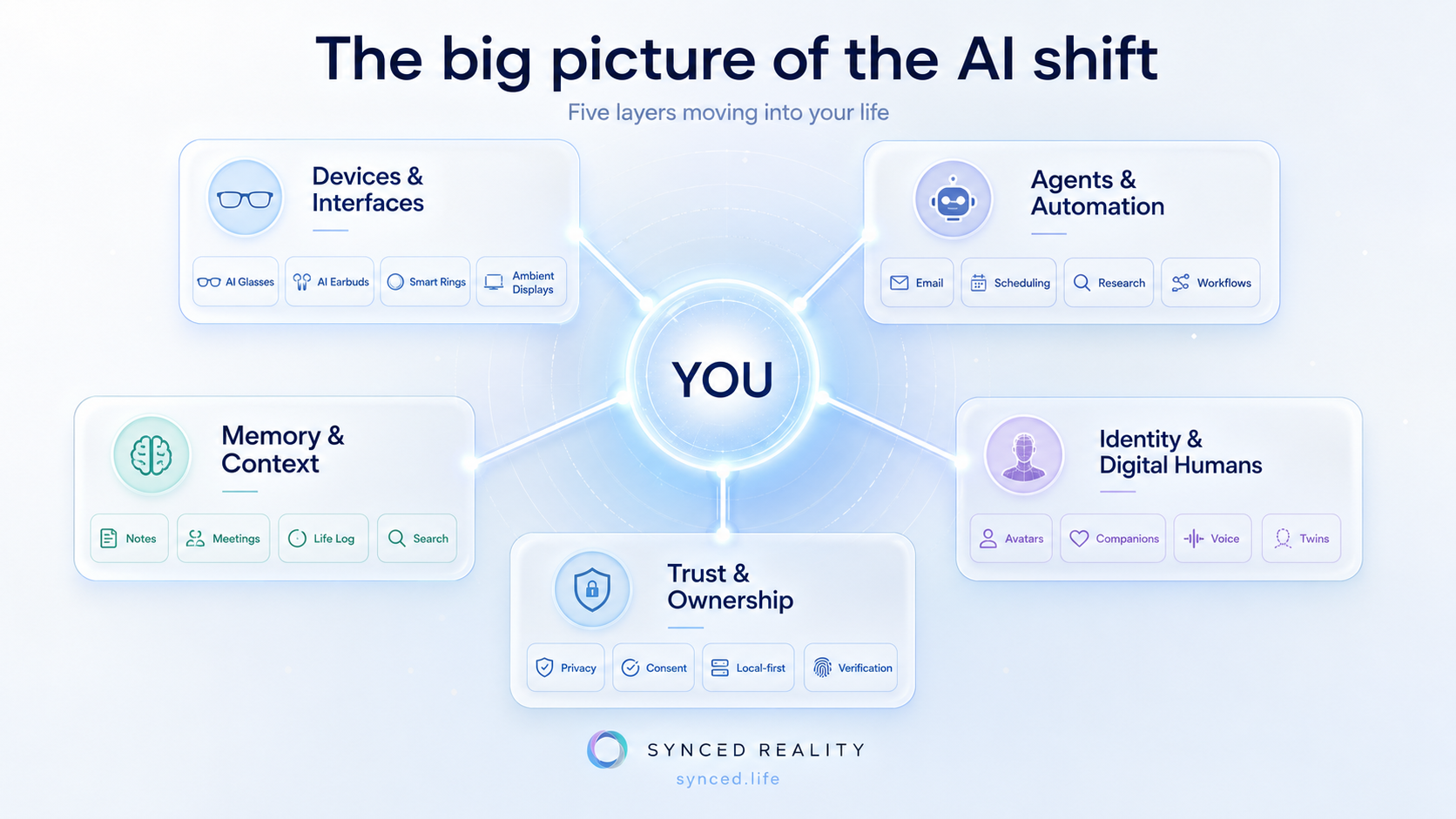
The hardware and interface layer where AI moves closer to the body and the real world: glasses, earbuds, rings and ambient displays.
This is where AI starts leaving the screen. The phone becomes less central when information can see, hear, sense and appear around you.
The strongest current signal here is the shift from smartphone-first computing to wearable and ambient interfaces.
Always-on sensors, unclear data ownership and a future where convenience grows faster than consent.
Agents, memory systems, wearables and context-aware software are beginning to connect previously separate pieces of digital life.
Glasses, earbuds, watches, spaces and autonomous agents increasingly become interfaces to digital intelligence.
People, devices and digital intelligence begin responding to place, presence, intent and relevant context — with trust and consent designed into the infrastructure.
No single product marks the transition. The signal is the convergence of technologies that make computing more contextual, ambient and present in the physical world.
AI is moving from answering questions toward planning, coordinating and executing tasks across digital systems.
Meetings, notes, voice, activity and personal context increasingly become persistent inputs rather than isolated data.
Glasses, earbuds, watches, rings and ambient interfaces move computing closer to the physical situations where it becomes useful.
Agents, digital humans and persistent personal context increasingly represent people across digital environments.
Location, proximity, presence, objects, environments and human intent begin to influence what digital systems do.
The closer technology gets to everyday reality, the more consent, local processing and ownership become architectural requirements rather than settings screens.
These are five visible signals of a larger shift: computing becoming less screen-bound and more closely connected to people, context and physical reality.
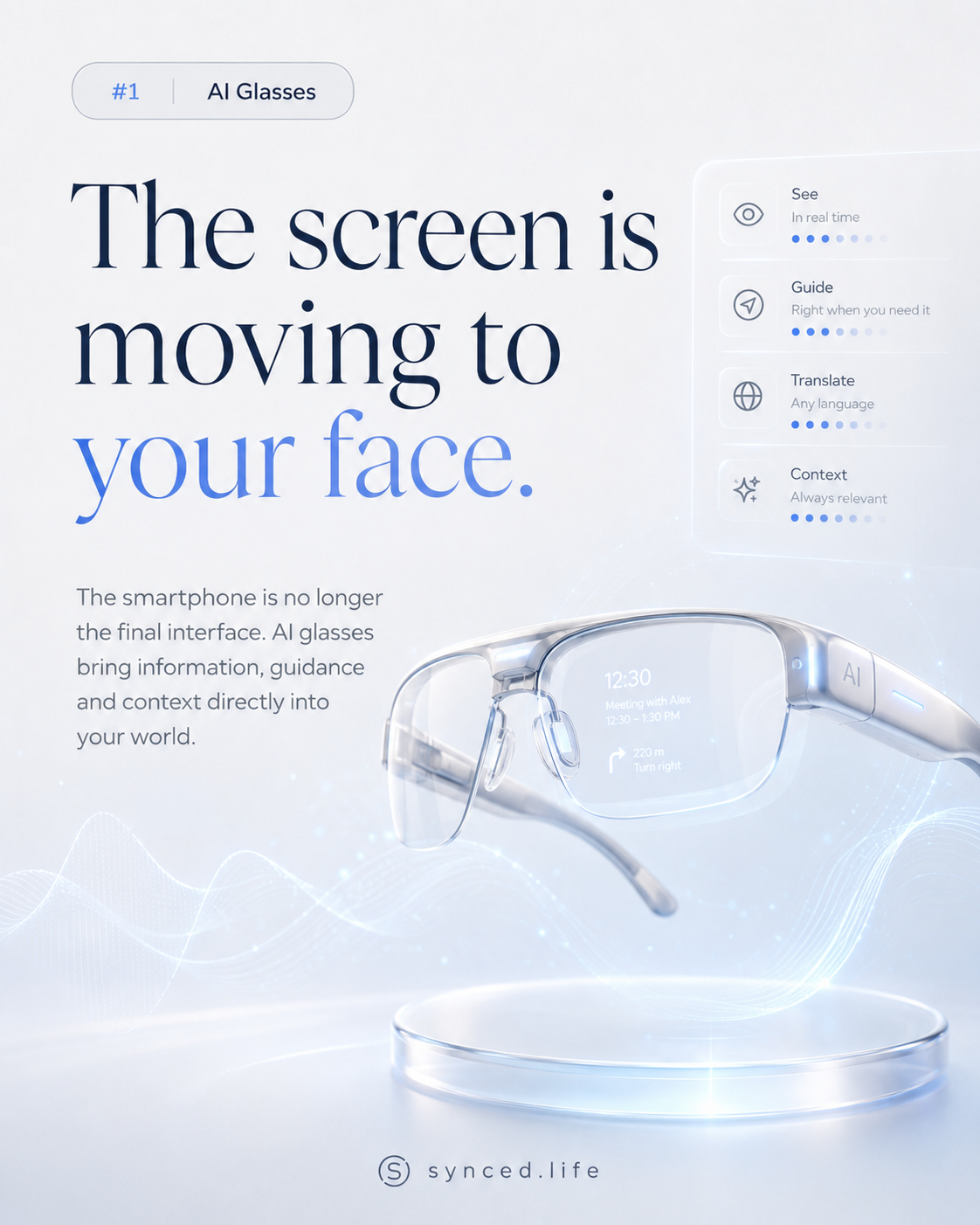
Information, guidance and context appear directly in your field of view.
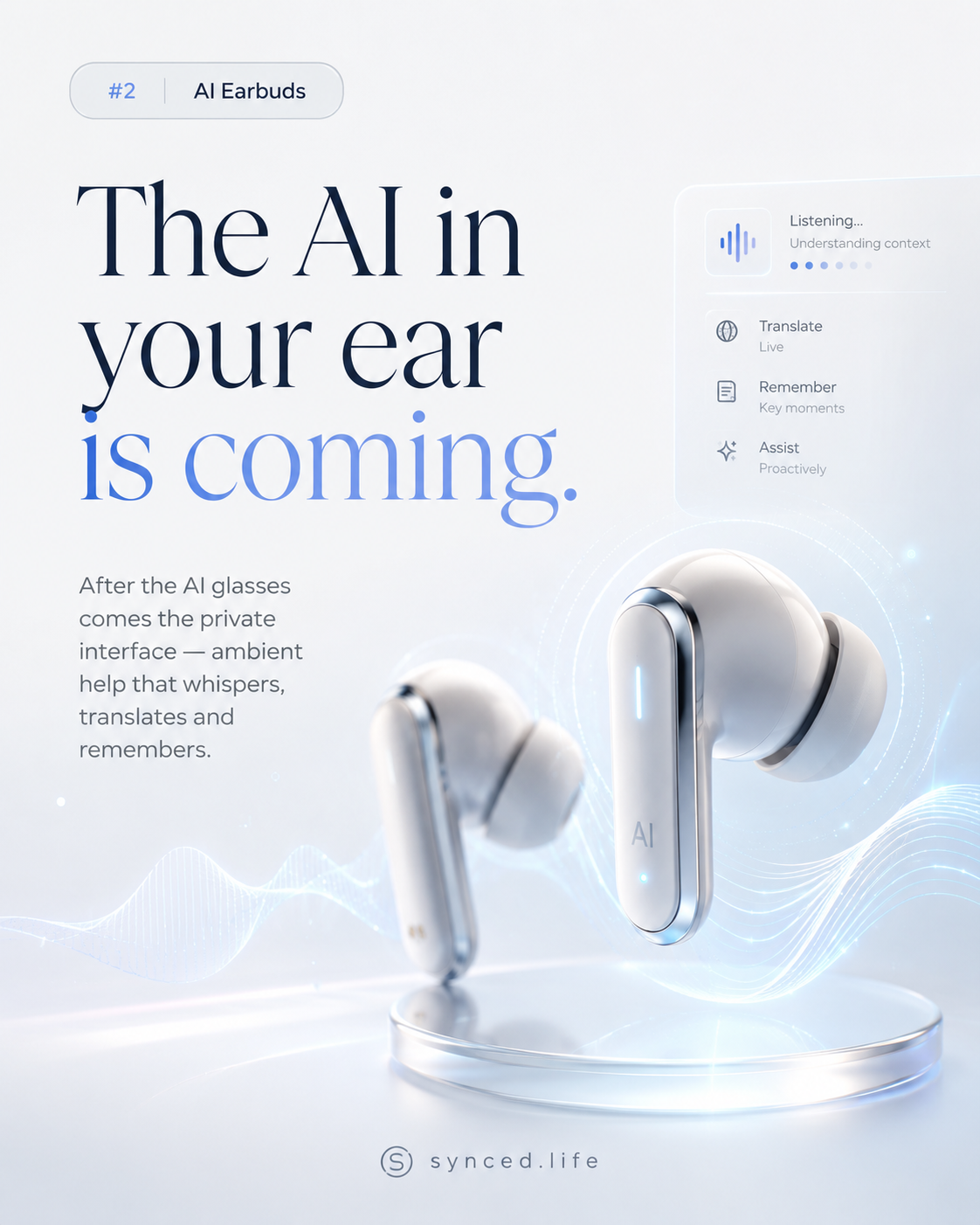
Your assistant stops sitting on a screen and starts whispering useful context.
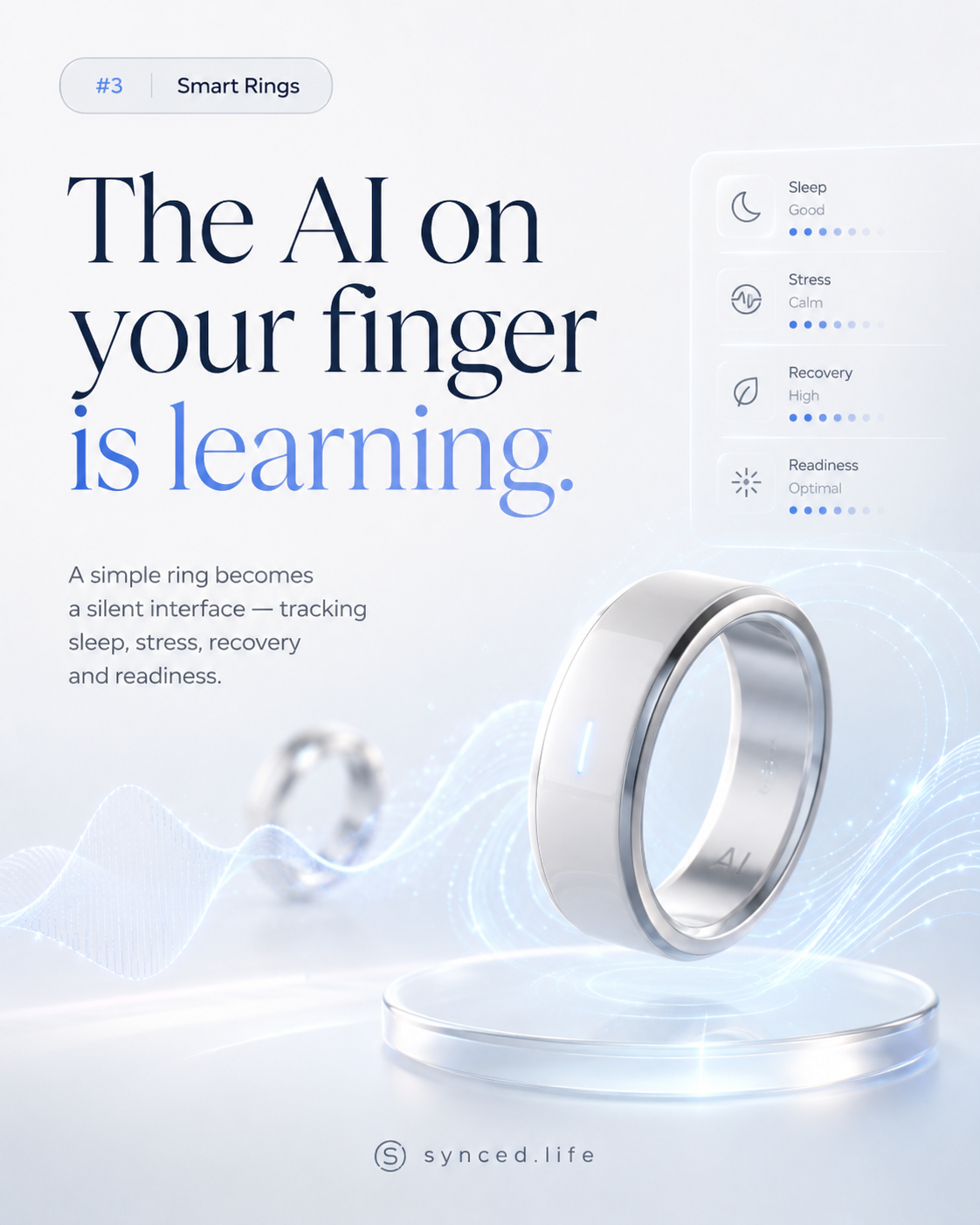
AI begins to understand how your body is feeling and responding.
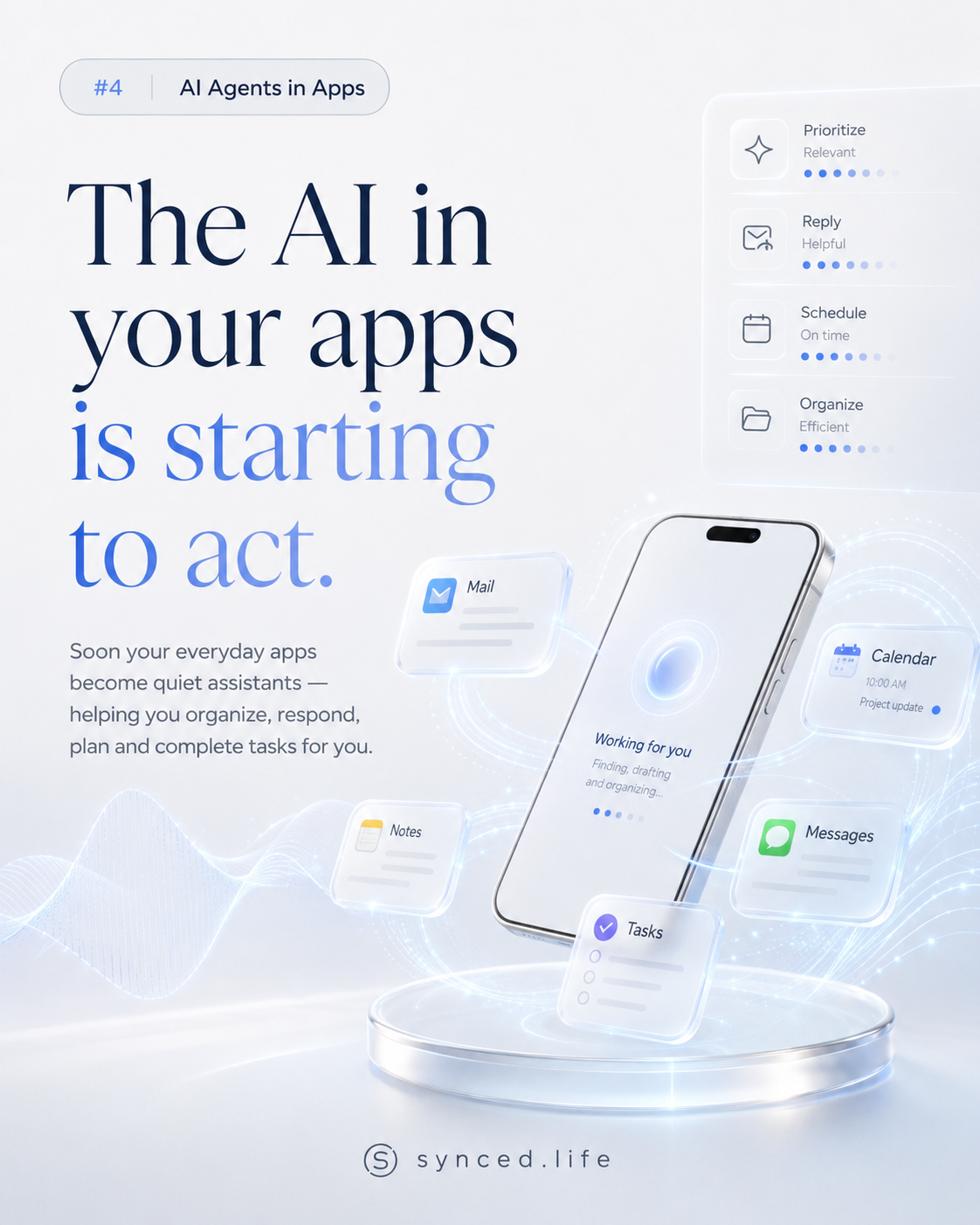
Apps start acting: replying, planning, sorting and handling small tasks.
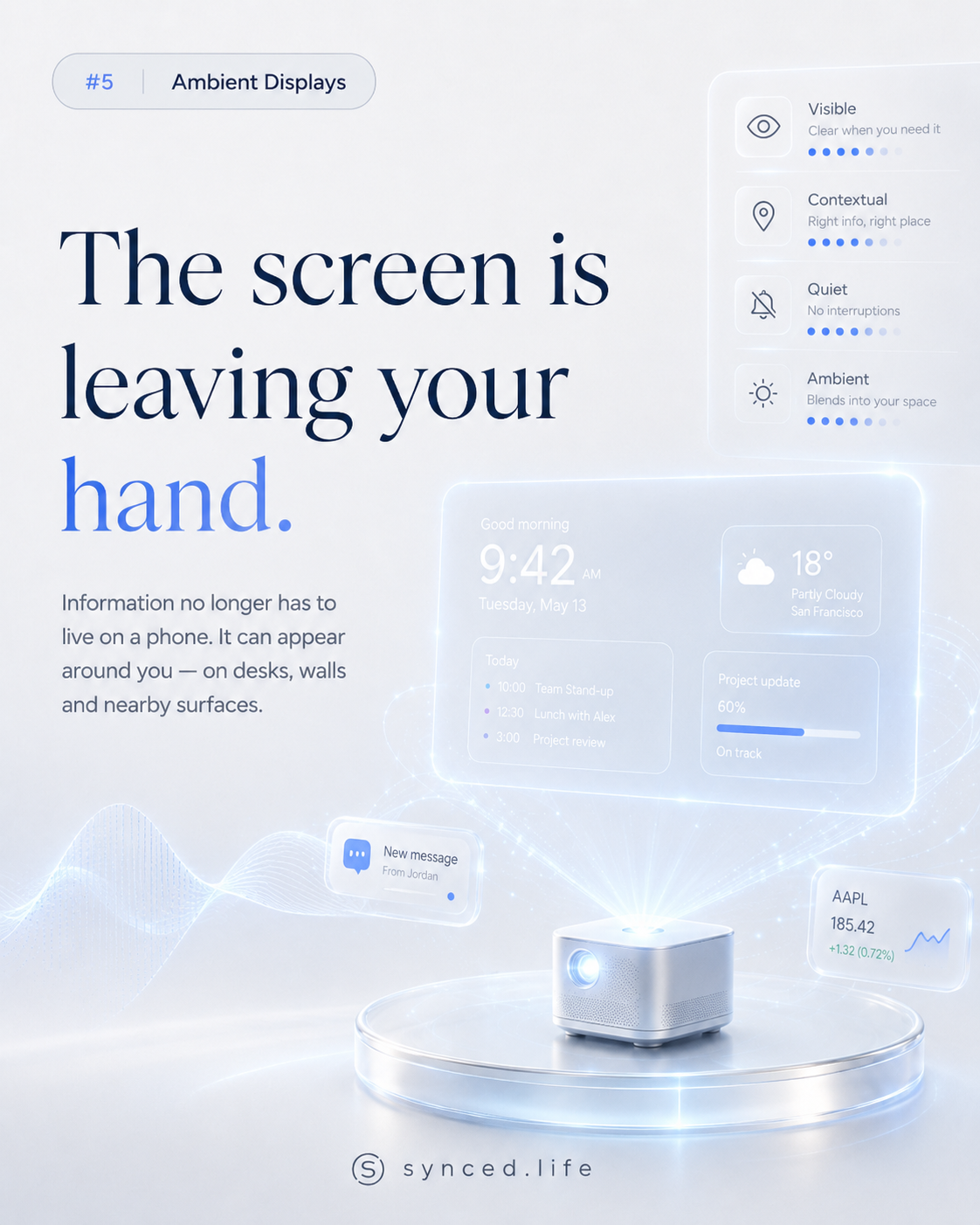
The screen leaves your hand and starts appearing in rooms and shared spaces.
InSync explores a simple but important question: what happens when technology can understand that another relevant person is physically nearby — without first turning everybody into dots on a centralized people map?
It combines local-first proximity, private relevance, staged disclosure and mutual consent. The phone is the interface today, but the underlying idea is broader: relevant context should eventually be able to move across wearables, ambient interfaces and future spatial devices.
AI is often described as a collection of tools. But underneath the launches and headlines, something larger is happening: intelligence is moving from isolated software into devices, agents, memory systems, interfaces and eventually the environments around us.
The important question is therefore not only which AI tool wins. It is what happens when the digital world starts understanding more about the physical world — and responding to it.
That is the territory Synced Life is building toward. The map makes the transition understandable. InSync begins testing it in the real world. Over time, the ambition is broader infrastructure for context, relevance, consent and interaction across Synced Reality.
Synced Life is a Caemso Nexus platform and technology direction. The surrounding channels explore different parts of the transition from smartphone-first computing toward a more contextual physical-digital world.
The main platform: mapping the transition, developing the thesis and building privacy-first technology for what comes after smartphone-first computing.
The destination: a context-aware reality where people, devices and digital intelligence can interact with the physical world more naturally and intelligently.
The interface lens: how digital intelligence can become a useful layer over physical reality without turning reality into another advertising surface.
Synced Reality becomes valuable when technology understands context. It becomes dangerous when understanding context automatically means collecting, centralizing and monetizing everything about people.
Context before distraction: technology should surface what matters instead of demanding constant attention.
Privacy in the architecture: minimize what needs to leave the device or become publicly visible.
Consent before disclosure: relevance can be discovered before identity or sensitive context needs to be exposed.
Human agency remains central: AI may understand context and suggest action, but people should remain in control of meaningful decisions and interaction.
Synced Life grew from work inside Caemso Nexus, where the original goal was to connect complexity to clarity around emerging technology. That exploration increasingly pointed toward one larger transition: the convergence of AI, context, devices, identity and the physical world.
Synced Life takes that thesis forward as a dedicated technology direction within Caemso Nexus. The map explains the transition. InSync is the first working product. The longer-term ambition is to help build the privacy-first context and relevance layer that Synced Reality will need.
The Blueprint turns the big AI shift into a practical 4-phase roadmap: Data Layer, Sound Layer, Agent Layer and Ambient Sync.
It shows how messy work becomes agent-ready execution — and what needs to be in place before AI agents, ambient interfaces and future wearables can actually support a business.
The Blueprint is the practical follow-up for people who want to turn the AI shift into workflows, systems and next steps.
Download the premium 10-page PDF for entrepreneurs preparing for agent-ready work, ambient interfaces and trust-first operations.
A practical 4-phase roadmap for entrepreneurs preparing for the agent era.
Data Layer → Sound Layer → Agent Layer → Ambient Sync.
From messy work to agent-ready execution.
A direct self-audit for your business.
Version 1.1 (2026)
The terminology can sound abstract. These are the direct answers to what Synced Life is building, what Synced Reality means and where InSync fits.
Synced Life is a Caemso Nexus platform building toward Synced Reality. Today it maps the transition from smartphone-first computing to AI-shaped reality and develops working privacy-first technology for real-world context, relevance and interaction.
Synced Reality is a future in which the physical and digital worlds become increasingly context-aware. Devices and digital intelligence can understand relevant real-world situations and respond at the right moment, while privacy, consent and user control remain part of the underlying design.
The long-term direction is a privacy-first context and relevance layer for Synced Reality: infrastructure that can help people, devices and digital intelligence understand what is relevant in a physical situation without requiring everything about everyone to be centrally tracked or publicly exposed.
InSync is the first working product demonstrating the Synced Life direction. It explores privacy-first real-world relevance: detecting meaningful mutual context between nearby people while keeping identity and deeper information private until appropriate consent exists.
SyncField is the local-first proximity and presence layer behind InSync. It helps turn nearby anonymous presence into a private real-world signal without requiring a public people map or continuous GPS tracking.
No. The map and content make the transition understandable, but Synced Life is moving beyond explanation into technology. InSync and SyncField are the first working examples of that direction.
Post-smartphone computing means the phone is no longer the only place where digital intelligence lives. Interaction increasingly moves into agents, wearables, earbuds, glasses, spaces and ambient interfaces that can respond to context.
Ambient AI is artificial intelligence that works in the background of everyday life through devices, wearables, spaces, agents and interfaces instead of only living inside individual applications.
Context-aware technology becomes more useful as it understands more about people and their surroundings. That same capability can become intrusive if everything must be collected centrally. Synced Life therefore explores local-first processing, temporary identifiers, progressive disclosure and consent as architectural principles rather than afterthoughts.
Synced Life is building toward that transition: making real-world context useful without making privacy optional. The map explains where the world is moving. InSync is where we have started building it.